Mohawk Watershed Symposium
Watershed symposium levels the playing field and brings together a variety of stakeholders
The Mohawk Watershed Symposium started in 2009 and has been more or less an annual event ever since (with the exception of the Covid years). Jaclyn Cockburn (then at Union College, now at University of Guelph) and John Garver (Union College) originated the idea and ran the Symposium at Union for the first decade. In 2019 (the 11th year), leadership transitioned to John Garver, Jacqueline Smith (Union College), and Carolyn Rodak (then at SUNY Polytechnic Institute, now at Union). In 2026 (16th year), Prof. Melissa DeSiervo from the Biology Department at Union joined the leadership team.
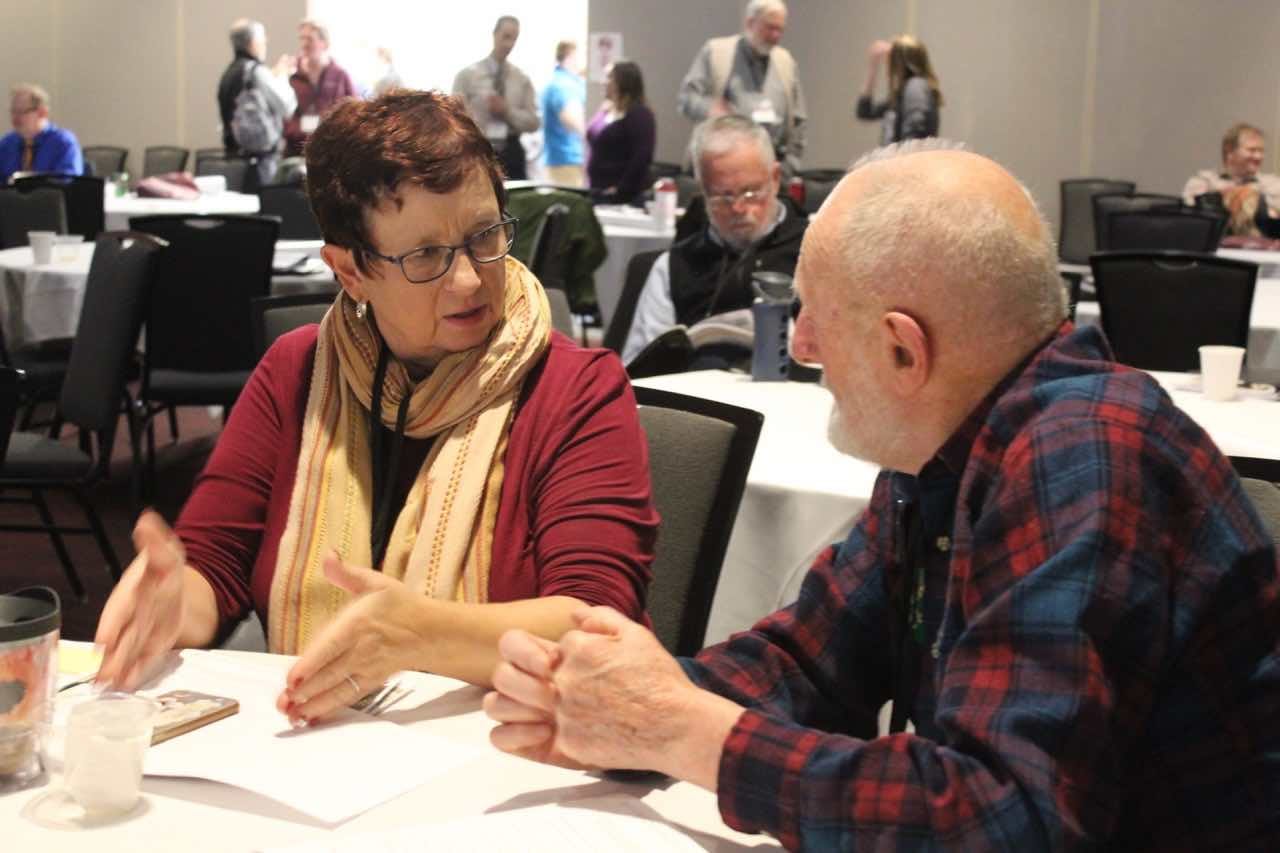
Discussion during a break between C. DeLaMarter (l), then President of the Stockade Association and J. Duggan (r). The opportunity to connect with colleagues is an important aspect of how the Symposium is structured (Photo: JI Garver).
The Symposium was initiated in the wake of a confluence of flood events in the Mohawk Basin that created an urgent need to understand those events in a regional context with stakeholder input. The Symposium also filled a perceived void in watershed management on the regional scale. In the words of the late Robert (Bob) Boyle, the Mohawk was “an orphaned watershed.” We wanted to fix that.
A number of prominent watershed-related events had attracted attention in the years and months leading up to the first Symposium in 2009. In 2005, Schoharie Creek was threatened by the potential failure of the Gilboa Dam (owned by NYC for water supply), which had recently been diagnosed with impaired embankments. In the following years (2006-07), the newly-formed Dam Concerned Citizens group was active in trying to intercede and guide remediation efforts for the Dam, which is part of the NYC water supply. The upper part of the Mohawk watershed was reeling from the 2006 floods caused by an unusual atmospheric stream from the south; this flood caused tremendous economic damage. Finally there were important consumptive-use issues on West Canada Creek; these issues – still ongoing – are rooted in court settlements that have been complicated by dam removal, growing communities, and commercial water demand.
At the time it seemed clear that chronic flooding, especially in the Schoharie watershed, was being driven by a substantial increase in annual precipitation. Together, these watershed management issues required a broader dialog among stakeholders. Thus the idea was born in the fall of 2008: let’s bring key stakeholders together and facilitate a dialog between them. The first Symposium was held on 27 March, 2009, in the Olin Center at Union College. Since inception there have been hundreds of poster and oral presentations. The annual program with extended abstracts is an important record of the event, and they are available for every year. The Mohawk Watershed Symposium has grown from 70-100 participants in the first few years to over 200 participants today.
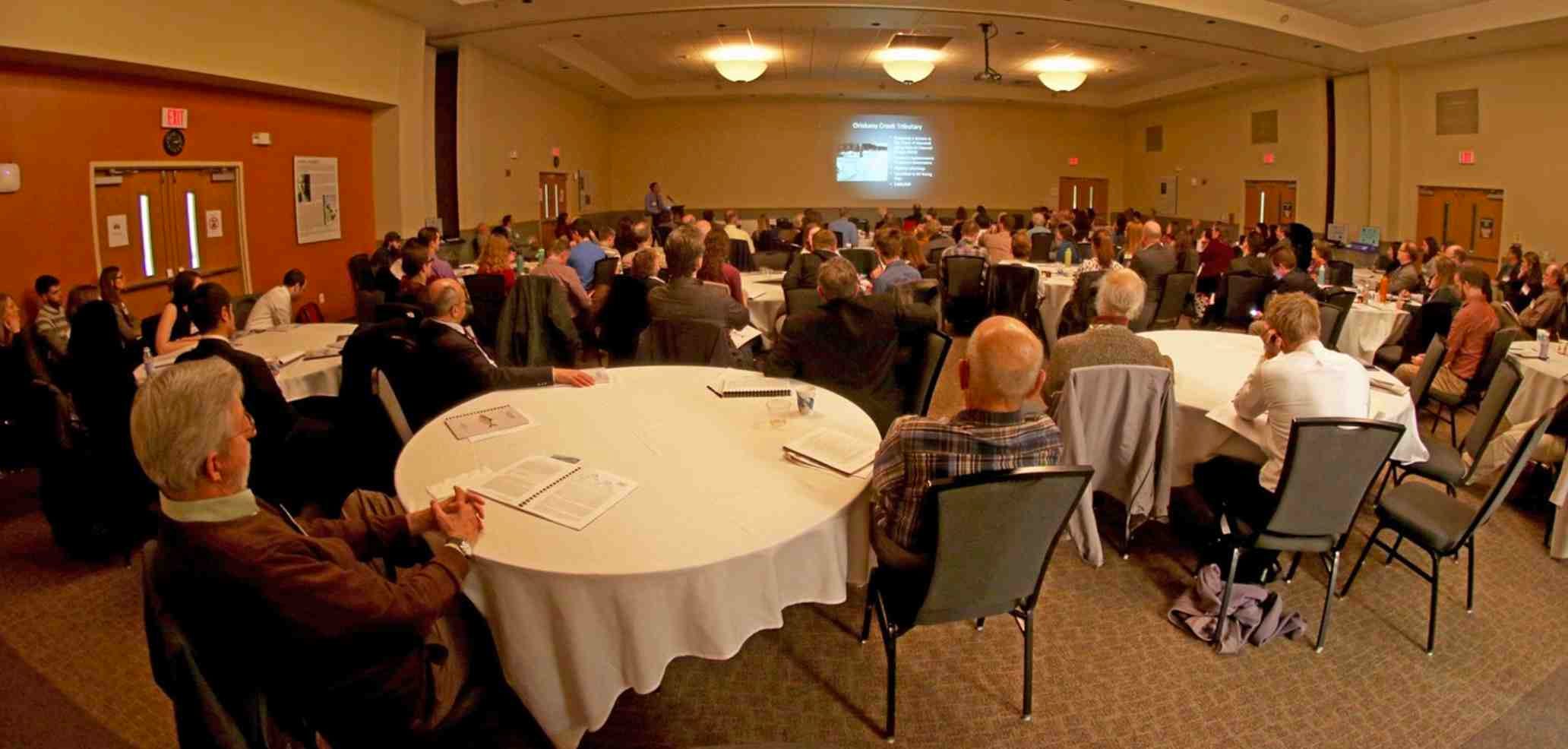
Oral presentation in the main lecture hall at College Park Hall (Photo: M. Milless)
The first year of the Symposium, 2009, was simple and essentially focused on encouraging participation and hearing from principal stakeholders. It involved a summary of the 2006 floods (Suro – USGS) and introductory talks by the West Canada Creek Riverkeepers (now WCC Alliance), and Dam Concerned Citizens in Schoharie. There were also talks from Canals, NYSDEC, and the Adirondack Park. The Keynote speaker in the first year was Robert Boyle, who was instrumental in getting the Symposium started.
In 2010 the Symposium was partly focused on the new Mohawk Basin Action Agenda that emerged from the DEC and basin stakeholders. The focus: watershed management, and the term Ecosystem Based Management was prominent in discussions. The NYS DEC program noted:
The mission of the Mohawk River Basin Program is to act as coordinator of basin-wide activities related to conserving, preserving, and restoring the environmental quality of the Mohawk River and its watershed, while managing the resource for a sustainable future. Vital to the success of the program is the involvement of stakeholders and partnerships with established programs and organizations throughout the basin.
At the same time, the Mohawk Watershed Coalition of Conservation Districts (herein the Coalition) was funded by the NYS Department of State, and that effort was very important at focusing remediation efforts in the watershed.
In July of 2010, Congressman Paul Tonko (then NY 21st congressional district, now the 20th) hosted the first Mighty Waters Conference at Schenectady County Community College. The conference focused on promoting sustainable and responsible waterfront development projects to “improve the quality of life in communities along the Hudson and Mohawk Rivers and Erie Canal.”
At the 2011 Symposium, the Coalition presented its overall plan for the watershed at the Symposium, and this was a major step in watershed management. The Keynote speaker was Congressman Tonko (then NY 21) who highlighted his Mighty Waters initiative, which had an initial vision of economic development along our scenic and inspiring waterways, especially waterfront development in cities and towns along the Mohawk. Later that year, Irene flooding on the Schoharie and the lower Mohawk changed things in a dramatic way. That flood event fundamentally changed the focus of Congressman Tonko’s initiative from economic development to recovery and rebuilding.
By 2011, discharge data from USGS gages had showed a marked change in flooding patterns in the Catskills. At the 2011 Symposium (five months before Irene flooding), Garver and Cockburn (2011) presented a talk entitled “Changes in the hydrology of the Mohawk watershed and implications for watershed management” and, as if we had a crystal ball, we wrote:
The importance of these [coastal tracking storm] events is that they can result in locally very high precipitation in the headwaters of the Schoharie (up to 10 inches or more in a few recent events), and very little precipitation elsewhere in the basin. Thus we hypothesize that the most dramatic and significant change in the hydrology in the Mohawk watershed is related to Atlantic-tracking storms, which have had a significant effect on flooding in the southernmost part of the watershed. We suggest that future studies focus on the meteorological and climatological implications of this hypothesis.”
Five months later Hurricane Irene resulted in the 500 yr flood on the Schoharie Creek causing millions of dollars in damage.
The 2012 Symposium was odd due to how profound and damaging Irene and Lee had been. This devastating flood event had upset all sorts of watershed and community development plans. Stakeholders were shaken, but the Symposium helped focus on rebuilding and resilience. This was the first Symposium supported financially by the NYS DEC, but it also received support from Brookfield Power and the USGS. In the Preface to the Symposium volume, we wrote: “[The] Historic and epic flooding in the Schoharie Creek has changed the political, economic, and physical landscape in a deep and profound way. More than ever, we are reminded of the importance of bringing key stakeholders together to present studies, develop strategies, and exchange ideas...” Assemblyman Peter Lopez (R-Schoharie – who later became director of EPA Region 2) gave a riveting Keynote address that described a personal perspective on the flood in Schoharie Creek.
In 2012, Congressman Tonko again addressed the Symposium as an invited speaker, and in his address he partly reshaped Mighty Waters. His office wrote “… the mission of Congressman Tonko's Mighty Waters Task Force is to help create a climate of investment, recovery and public awareness for the waterways and communities of the upper Hudson and Mohawk Rivers and Erie Canal by mobilizing federal resources that encourage policy reform, economic development, public enjoyment and effective environmental stewardship.” Later in June of that year, Congressman Tonko introduced the “Hudson-Mohawk River Basin Act of 2012” in Congress; this bill would have allowed for regional watershed management (the bill lingered in committee, and was re-introduced several times since). This bill eventually re-emerged as the The NY-NJ Watershed Protection Act (S4677 and HR 4677), which passed in the US House of Representatives in 2022, and but did not pass in the Senate in late 2022.
The 2013 Symposium followed Hurricane Sandy, which had a direct and profound effect on the decision-making process in the watershed because pre-emptive releases were made (although the event lacked significant rain in the watershed). Thus we learned that water management was possible, and this was a direct lesson from Irene/Lee. With the introduction of the Hudson-Mohawk River Basin Act of 2012 in Congress, we were eying National Blueways status in the Mohawk-Hudson, and we were hoping that the keynote speaker, Rebecca Wodder (Senior Advisor to the Secretary of the Interior), would help with that (the Blueways program was terminated several years later).
In the preface to the 2014 Symposium volume, we wrote: “This is a unique conference, partly because few watersheds enjoy such annual attention. But it is also unique because the informal setting and accessibility of the format has leveled the playing field and allows for equal participation by all stakeholders. From this approach we learn of new Federal and State funding initiatives, but we also learn of the struggles and successes of small non-profit and educational efforts that are making a difference in the Watershed. Thus the conference has evolved into a unique forum where all stakeholders have equal footing.” In 2014 we obliquely took on dams. Our keynote speaker was Laura Rose Day, Executive Director of the Penobscot River Restoration Trust, who had been involved in removing dams in Maine.
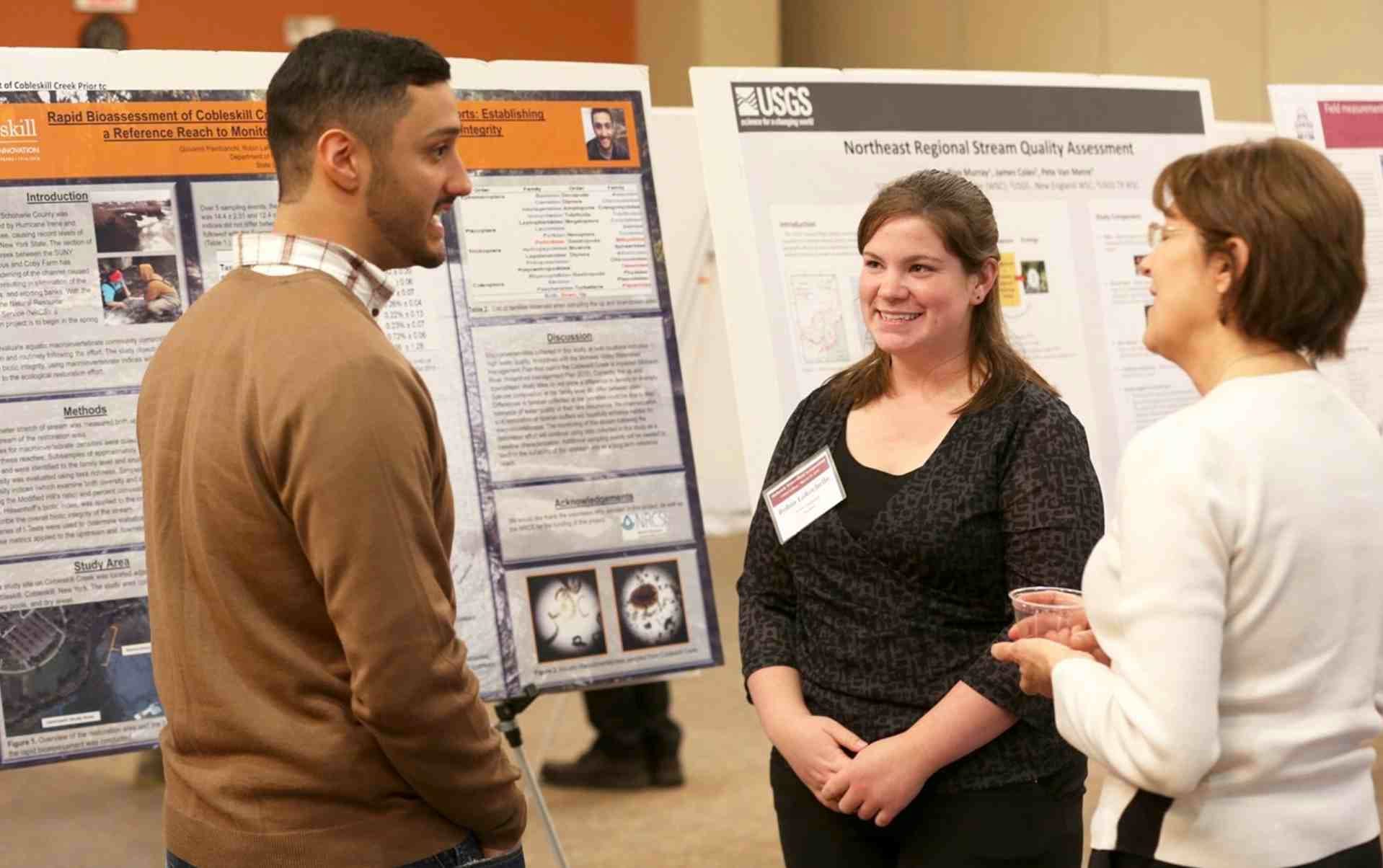
Poster presentations are a central part of the communication of science at the meeting (Photo M. Milless).
In 2015 we focused on clean water, and we wrote in the Preface: “…we need to focus part of our efforts on water quality because with clean water we have exciting opportunities in community revitalization and recreation.” Part of this was a response to the Mighty Waters Initiative (Tonko) that was still active, but to a large extent it was related to new opportunities. In some sense, this may have been a “watershed” year for the basin. Although Congressman Tonko gave a plenary address, the Keynote speaker was John Lipscomb, Riverkeeper Patrol Boat Captain and environmental advocate. In 2014 Riverkeeper conducted the first exploratory patrols on the Mohawk, and the interaction with Riverkeeper has been transformative and ongoing since.
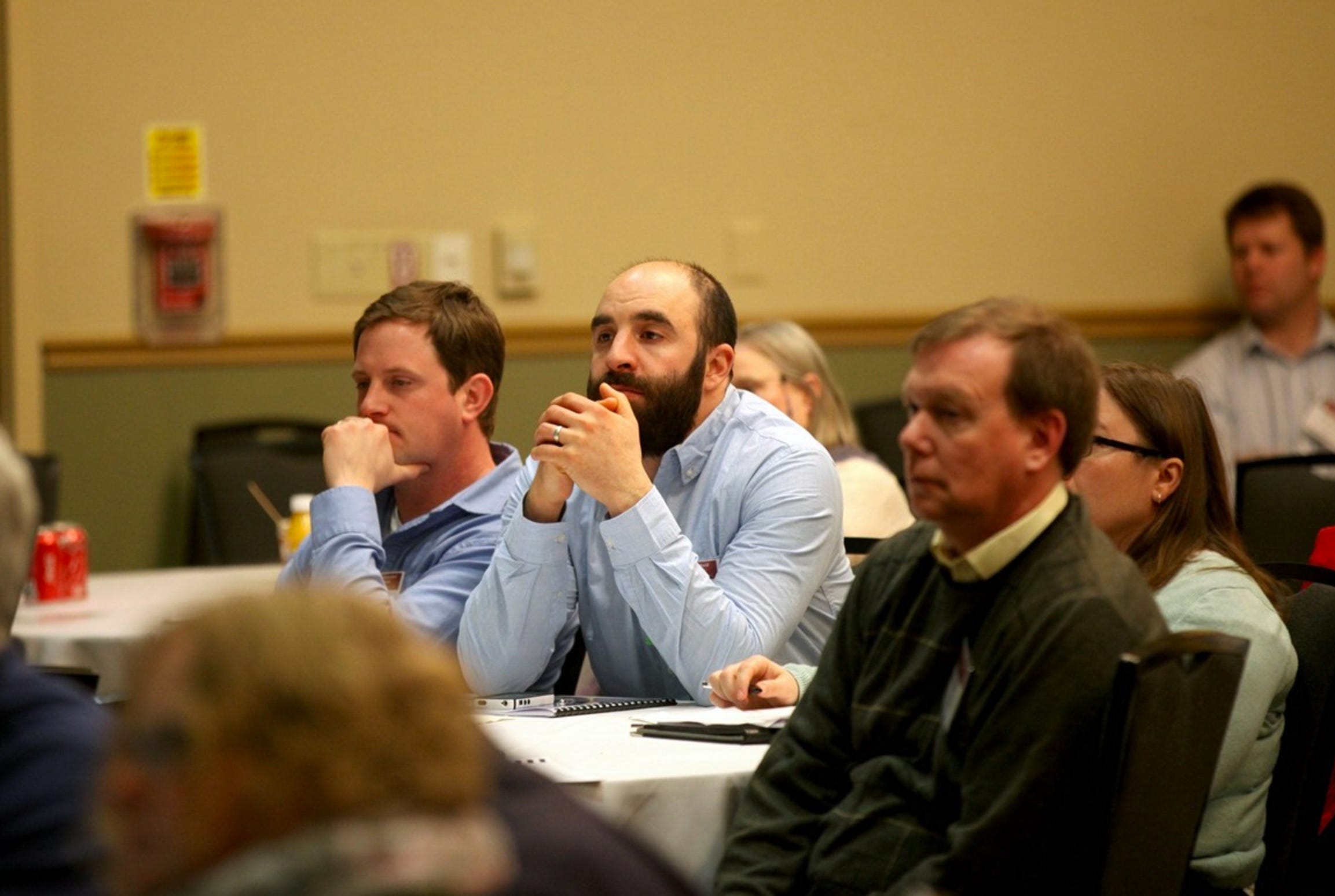
Chris Gazoorian of the USGS and others listen to a talk in 2015 (Photo: M. Milless).
In 2016 we continued to focus on water quality and ecology. Karin Limburg (SUNY ESF), an ecologist and long-term supporter of the symposium, delivered a Keynote on herring and the importance of fish in the Mohawk ecosystem. Congressman Tonko again participated and highlighted the newly introduce AQUA act. Bob Boyle, a long-time supporter of the Symposium gave an inspired invited talk that warned of ongoing threats to the water quality of the River. In 2016, Garver and Cockburn published a Groundwork article entitled “Building a coalition of concerned stakeholders to guide watershed decisions” in GSA Today (see Cockburn and Garver, 2016 citation below). This paper gave an overview of the symposium: its goals, strategy, and successes. This is an important starting point for anyone looking into the history of the symposium.
In 2017 water quality continued to be an important theme, partly because new accessible data were coming in from Riverkeeper and partners. To some extent, the framework envisioned in the previous few years was yielding results and there were some important milestones. The city of Amsterdam struggled with leaking sewage in the river, while simultaneously opening the new footbridge designed to get people to interact with the River. The riverfront casino complex opened in Schenectady, so to some extent the vision of Congressman Tonko (Mighty Waters) was coming to fruition. 2017 was the first year we had presentations from projects directly funded by the Mohawk River Basin Program (DEC), and thus this was a major milestone because prior to that program, there had been no funding mechanism in the basin.
In 2018 we celebrated ten years. The Symposium had matured and had become a regular event that attracted a wide spectrum of participants, and by some metrics the conference had become established in this mature way since 2015. Garver gave a summary of the epic ice jam of January-February 2018, which was 18 miles long and caused flooding and damage in the Stockade of Schenectady. We took on water quality, flooding, and the new Action agenda that was being formulated and facilitated by the NYS DEC.
In 2019 we had a partial change in leadership, but carried on with guiding science and policy in the watershed. A major theme of this conference was infrastructure and ecosystems. We heard about the rehabilitated Gilboa Dam and upgraded sewer systems in Utica. The Keynote speaker was Rep. Antonio Delgado (NY19) who was then on the Transportation and Infrastructure Committee in the US House of Representatives. Ice jams continue to be problem, and a State effort to address the cause was presented. Meanwhile the City of Schenectady, with the help of FEMA, is taking on chronic flooding in the Stockade, and phase one of that study was presented at the Symposium.
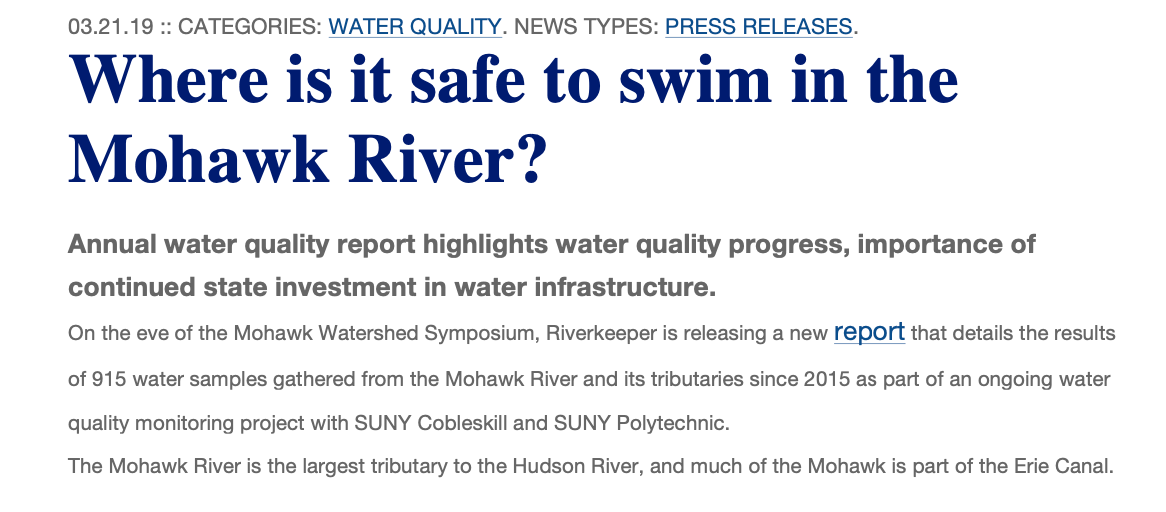
Press Releases are prepared and released in anticipation of the Symposium. Here, Riverkeeper releases the results of water quality testing in the Mohawk River from the previous year.
Major changes for the Mohawk watershed were in store following the Reimagine the Canals initiative, which was initiated by Governor Cuomo in 2019, but the final report landed on his desk in early 2020. The Reimagine the Canals task force took on a number of issues related to the entire Erie Canal. Issues included water for irrigation, invasive species, flooding, and ice jamming. The Mohawk was perhaps the most complicated because the Canal and the main stem of the Mohawk need to co-exist despite change in the watershed. The task force effort included the Mohawk Flood Assessment aimed at evaluating benefits from a number of flood mitigation strategies along the length of the River. It also acted on a separate report on ice jamming in the Schenectady Pool in front of the Vischer Ferry Dam, at Lock E7. Much of this effort was to be highlighted in the 2020 symposium, which was cancelled the week before the conference due to the Pandemic (but the abstract volume was produced and is available here). A dangling issue from the Task Force was addressing invasive species, including consideration of methods to block organisms from using the Erie Canal - the “Invasive Superhighway” - that connect the Great Lakes watershed from the Hudson-Mohawk.
The 12th Symposium, which was scheduled to be on 20 March 2020, was cancelled because of the Pandemic. We had solicited abstracts, assembled the schedule, but then the painful decision was made to “postpone” the Symposium ten days before it was supposed to have happened, but it was never rescheduled. We did publish the abstract volume. This meeting would have highlighted important work done by the Reimagine the Canals task force, and flooding from the Halloween Storm of 2019. The 2021 and in 2022 Symposiums were cancelled due to the Pandemic (no abstract volumes).
The 13th Mohawk Watershed Symposium was held on 17 March 2023 was the first full symposium following the Pandemic. We addressed the new threat of the invasive species, including the Round Goby that successfully invaded and dispersed through the watershed in the last few years.
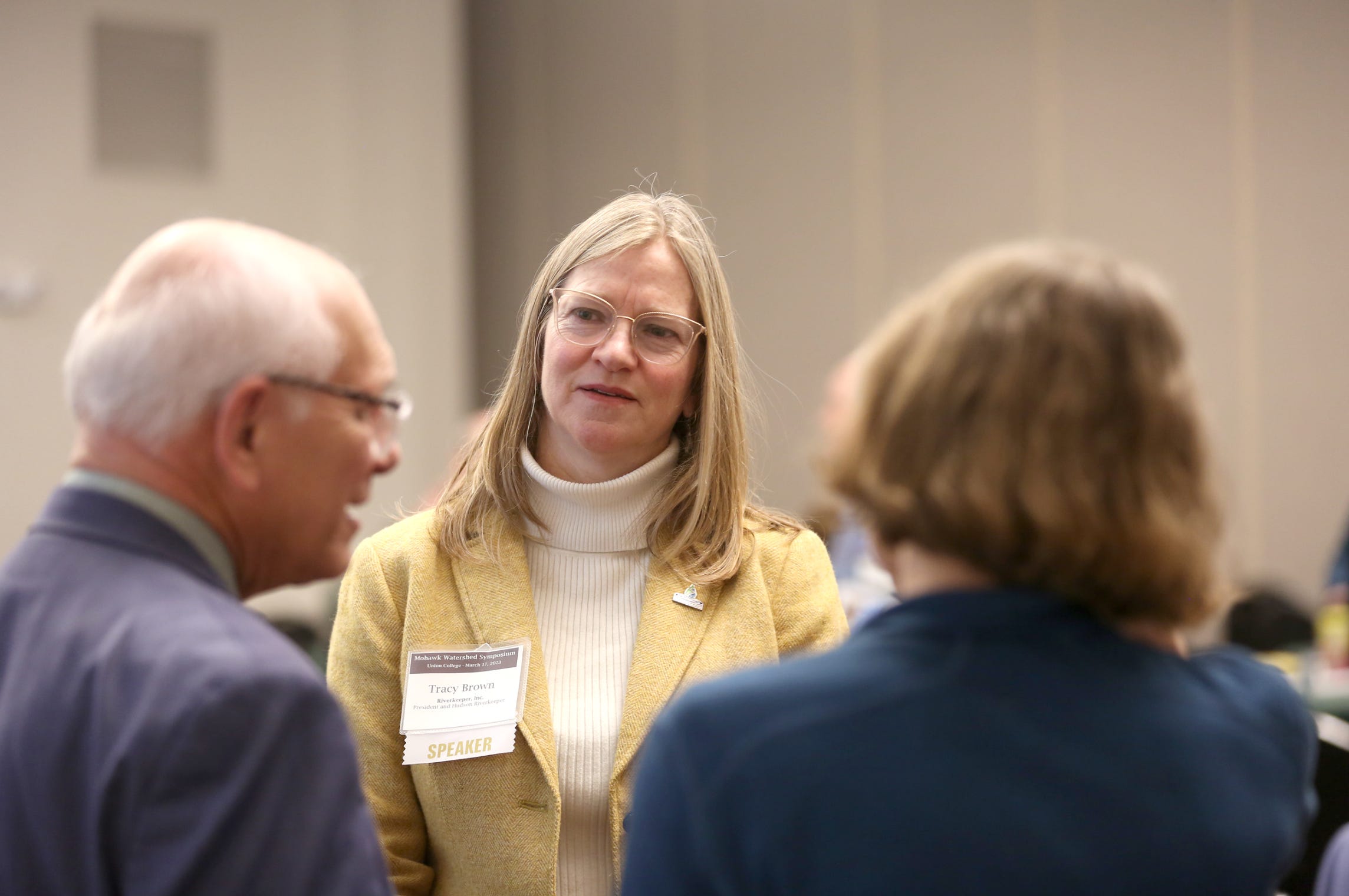
Tracy Brown, President of Riverkeeper, spoke at the 2023 Symposium and delivered a message of collaboration and cooperation in addressing water quality in the Hudson-Mohawk watershed (Photo: M. Milless).
The 14th Symposium, on 14 March 2024, had a of diverse talks and posters and a record attendance that exceeded 180. John Lipscomb, Captain of the Riverkeeper Patrol Boat, provided parting words in an emotional talk entitled “My time on the Mohawk.” One key message from John is that we need to change how the Canal and the River are managed. The fact that the Erie Canal is in the river complicates management and has resulted in all sorts of problems that were not anticipated when that transition occurred a century ago. We highlighted the retirement of Kathy Czajkowski, Mohawk Watershed Coordinator. As watershed coordinator she played an important role in facilitating stakeholder engagement and implementing the Mohawk River Action Agenda, which is our guiding document - our blueprint for action in the basin. The mission of the Action Agenda is to conserve, preserve, and restore the environmental quality of the Mohawk River, helping to manage the watershed’s resources for a sustainable future.
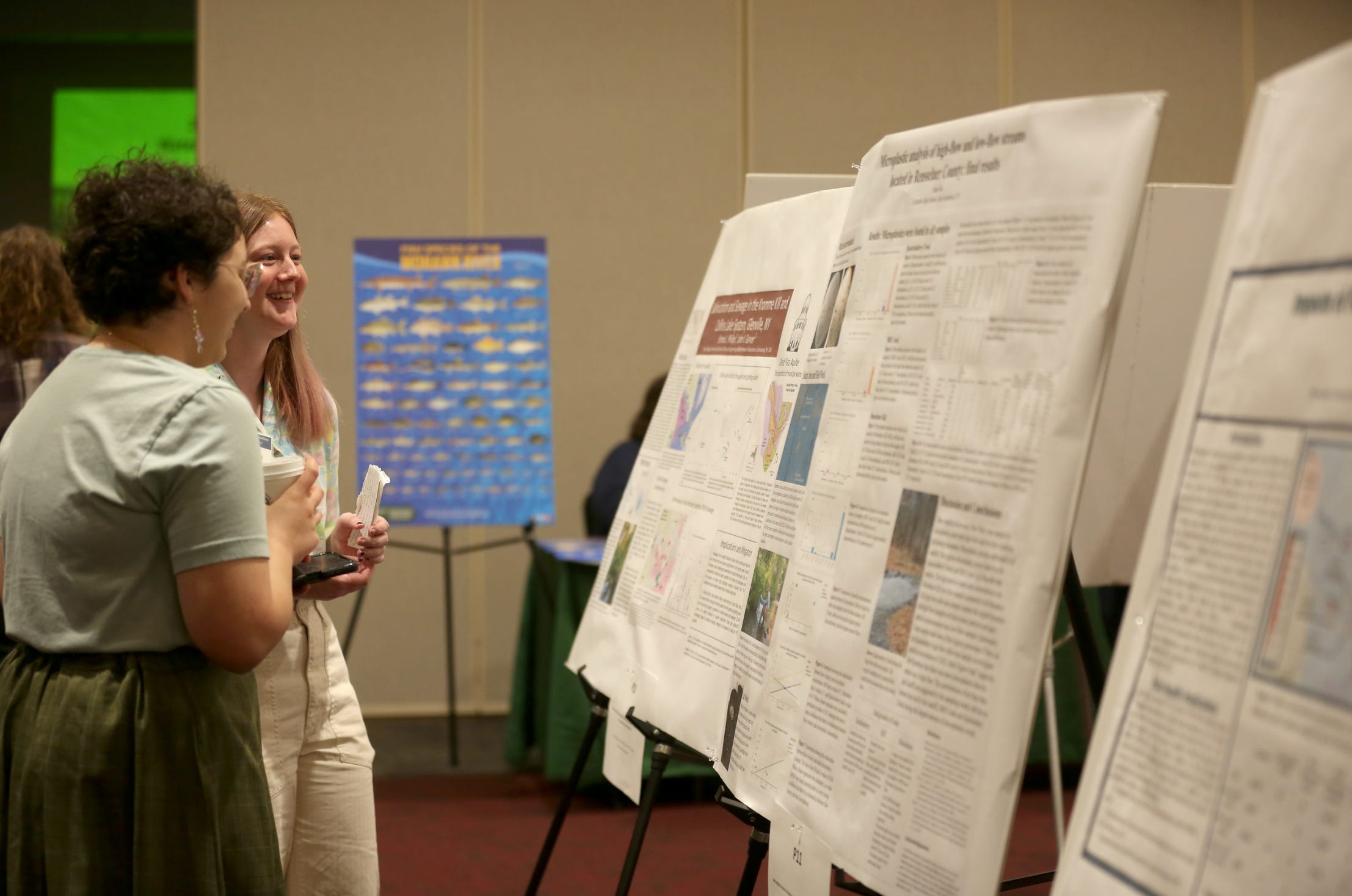
Student Emma Phillips explains water quality in the Kroome Kill creek in Glenville in 2023 (Photo: M. Milless).
The 15th Mohawk Watershed Symposium was held on 21 March 2025. The political landscape had changed in a dramatic way and we were all reminded that we need to redouble our efforts to advocate for clean water and ecosystem health,
The 16th Mohawk Watershed Symposium will be held on 20 March 2026, with a record pre-registration of well over 200. I am retiring this year during a time of dramatic change, but I am certain that the symposium is in good hands.
This and other Notes from a Watershed are available at: https://mohawk.substack.com/
References
Cockburn, JMH, and Garver, JI, 2016, Building a coalition of concerned stakeholders to guide watershed decisions, GSA Today, 26 (3).